
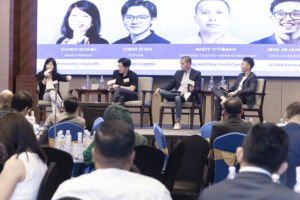
At the Advanced Innovation & Manufacturing (AIM) Asia Summit 2026, one of the most candid and insightful discussions focused on a challenge that continues to slow industrial innovation across ASEAN: the disconnect between corporates and startups. Under the panel theme, “Unlocking Investment, Funding & Capital Raising Opportunities for Deep Tech Innovators & Manufacturing Scale ups to Fuel Growth, Competitiveness & Global Expansion,” industry leaders explored why many promising collaborations between large enterprises and startups struggle to move beyond pilots, proofs-of-concept, or innovation showcases. The conversation highlighted a growing reality across the advanced manufacturing and deep tech ecosystem. While corporations increasingly recognise the importance of innovation, AI, robotics, automation, and smart manufacturing technologies, many startups still face major structural barriers when attempting to work with large enterprises. More importantly, the panel revealed that the real innovation gap is often not technology itself, but alignment, procurement processes, internal corporate culture, and ecosystem readiness.
The Startup Talent Gap Is Even More Severe
The discussion began with a reflection on talent challenges within manufacturing and innovation ecosystems. While much attention is often placed on workforce shortages in manufacturing, the panel highlighted that the talent gap within startups is even more severe, particularly in deep tech and industrial innovation sectors. Experienced professionals with large-scale manufacturing expertise are often already embedded within multinational corporations, industrial operations, and established enterprises. Very few are willing to transition into startup environments due to uncertainty, operational pressure, and financial risk. This creates a major capability gap for startups attempting to scale industrial technologies, robotics solutions, automation systems, and AI-driven manufacturing platforms. The discussion reinforced an important point for ASEAN’s innovation ecosystem: Deep tech startups do not only require funding.
They require experienced operational talent, industrial expertise, and ecosystem support to scale successfully.

Why Corporate–Startup Collaboration Matters More Than Ever
As manufacturing industries move towards Industry 5.0, automation, AI adoption, robotics integration, and digital transformation, corporations are increasingly realising that they cannot innovate entirely on their own. The panel explored how large enterprises are becoming more open to working with startups to accelerate transformation initiatives, solve operational challenges faster, and access emerging technologies more efficiently. One speaker shared how corporate innovation ecosystems are evolving rapidly, especially in sectors such as manufacturing, robotics, industrial automation, and smart factory development. However, successful collaboration does not happen automatically. A major insight from the session was the reality that corporate-startup partnerships require significant ecosystem facilitation, relationship management, and operational translation between both sides. The discussion openly acknowledged that startups and corporates operate at completely different speeds, expectations, and organisational structures. Startups prioritise agility, speed, experimentation, and rapid scaling. Corporates operate through governance, procurement structures, hierarchy, compliance, approvals, and risk management. Bridging these two worlds requires far more than simply introducing both parties to each other.

The Procurement Trap Slowing Manufacturing Innovation
One of the strongest themes throughout the discussion was what many described as the “innovation trap” created by traditional procurement systems. The panel highlighted how standard enterprise procurement cycles often make collaboration nearly impossible for startups. Many corporate procurement systems involve:
– Long approval timelines
– Multiple stakeholder layers
– Complex vendor qualification requirements
– Lengthy documentation processes
– Extended payment cycles
– Rigid operational expectations
For early-stage startups, these systems create major financial and operational strain. Unlike large corporations, startups typically do not have significant cash reserves to survive prolonged enterprise sales cycles. The panel explained that many promising manufacturing and robotics startups fail to secure enterprise partnerships not because their solutions are weak, but because they cannot survive the procurement process itself. This is becoming a growing issue across ASEAN’s deep tech ecosystem. The discussion emphasised that if corporates genuinely want innovation, they must rethink how they engage with startups operationally.

A Real Manufacturing Innovation Case Study
One of the most practical insights shared during the panel was a successful case study involving corporate-startup collaboration in the smart manufacturing sector. The discussion highlighted how a Malaysian manufacturing startup specialising in robotics solutions successfully collaborated with a major corporate organisation to deliver robotics and smart manufacturing capabilities. What made the collaboration successful was not only the technology itself, but the ecosystem facilitation behind it. The panel explained that successful partnerships often require:
– Active relationship management
– Expectation alignment
– Internal stakeholder coordination
– Procurement adaptation
– Operational translation between both parties
– Patience from both corporates and startups
This reinforces a major lesson for industrial innovation ecosystems:
Technology alone is rarely enough. Execution, alignment, and ecosystem orchestration are what drive successful innovation adoption.

Why Leadership Buy-In Changes Everything
Another important theme explored during the session was leadership alignment within corporates. The panel noted that transformation becomes significantly easier when senior leadership genuinely believes in startup collaboration and innovation-driven change. If corporate leadership has the appetite to transform, internal resistance becomes easier to overcome. Without executive support, however, many innovation initiatives remain trapped within experimentation phases without ever scaling into real business deployment. The discussion highlighted that many corporations today already have innovation departments or transformation teams. However, a common challenge is that these innovation units are sometimes disconnected from actual business units and operational pain points. This creates a dangerous misalignment. For example:
– Innovation teams may be measured by the number of pilots conducted
– Business units may prioritise operational efficiency and profitability
– Startups may expect rapid deployment opportunities
– Procurement teams may focus primarily on risk avoidance
Without alignment between these groups, innovation projects often stall before delivering measurable value.
The Need for Genuine Demand, Not Innovation Theatre
A particularly important insight from the panel focused on the difference between genuine innovation demand and “innovation theatre.” The discussion pointed out that some organisations launch startup initiatives primarily for branding, visibility, or ecosystem positioning rather than solving real operational challenges. However, startups can only succeed when there is authentic demand from the business itself.
The panel stressed that manufacturing companies must clearly identify:
– Real operational pain points
– Business-driven use cases
– Measurable productivity opportunities
– Clear deployment objectives
– Internal ownership and accountability
Without these elements, startup partnerships risk becoming short-term experiments rather than long-term transformation initiatives. The conversation reinforced that the most successful innovation ecosystems are driven by real industrial pull, not symbolic innovation activities.

Why ASEAN Manufacturing Needs Stronger Innovation Ecosystems
As ASEAN positions itself as a major global hub for advanced manufacturing, industrial automation, AI adoption, robotics deployment, and deep tech innovation, stronger collaboration between startups, corporates, governments, and ecosystem builders is becoming increasingly important. The panel highlighted that governments also play a critical role in supporting the supply side of innovation ecosystems, particularly by helping startups access:
– Industrial partnerships
– Pilot opportunities
– Manufacturing networks
– Talent ecosystems
– Funding pathways
– Regional market expansion
Meanwhile, corporates must become more open, agile, and intentional in how they engage innovation partners. The future of manufacturing competitiveness will increasingly depend on how effectively ecosystems can collaborate across:
– Deep tech innovation
– Manufacturing transformation
– AI and automation adoption
– Smart manufacturing deployment
– Robotics integration
– Cross-border industrial partnerships
Building Long-Term Manufacturing Innovation Partnerships
The session concluded with a clear message for the future of industrial innovation in ASEAN:
Corporate-startup collaboration is not a short-term transaction.
It is a long-term journey that requires patience, alignment, trust, and ecosystem maturity.
Successful partnerships require:
– Leadership commitment
– Operational clarity
– Shared expectations
– Flexible collaboration models
– Internal alignment
– Real business demand
– Long-term value creation
As Industry 5.0 reshapes manufacturing globally, the companies and ecosystems that succeed will be those capable of connecting innovation with execution.
The AIM Asia Summit 2026 once again reinforced its role as a platform bringing together manufacturers, startups, investors, government agencies, and technology leaders to drive conversations around Innovation, Investment, and Impact across Asia. For more insights on advanced manufacturing, deep tech innovation, smart manufacturing, industrial AI, robotics, sustainability, and Industry 5.0 transformation, stay connected with AIM Asia. Join us at our upcoming AIM Asia series of programmes as we continue shaping the future of manufacturing, investment, and industrial innovation across ASEAN.
Connect with us to gain access to the exclusive AIM Circle platform and stay connected with industry leaders and opportunities across the advanced manufacturing ecosystem.
For AIM Circle access, speaking, sponsorship, exhibition, and partnership opportunities, contact [email protected] or +65 8868 1418 (SG) | +6011 1616 3281 (MY)
#AIMAsia #AdvancedInnovationAndManufacturing #DeepTech #StartupEcosystem #CorporateInnovation #SmartManufacturing #Industry50 #ManufacturingInnovation #ASEANBusiness #IndustrialTransformation #Automation #AI #Robotics #CrossBorderCollaboration #InnovationEcosystem