
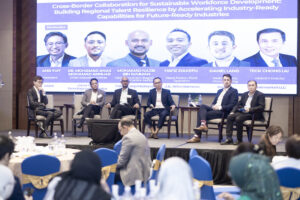
As industries across Southeast Asia navigate digital transformation, evolving customer expectations, and increasing global uncertainty, one challenge continues to surface across manufacturing, technology, and industrial sectors: how do organisations build a workforce that is not only skilled, but resilient, accountable, and capable of sustaining quality at every level? This important topic was explored during a panel discussion at the AIM Asia Summit Johor 2026, where industry leaders examined the role of workforce development, organisational culture, and cross-border collaboration in preparing talent for future-ready industries. The session highlighted a critical reality facing manufacturers today: technology alone does not create operational excellence. Sustainable competitiveness ultimately depends on people, culture, and the ability to continuously develop industry-ready capabilities.
Why Workforce Development Has Become a Strategic Priority
As industries embrace automation, artificial intelligence, advanced manufacturing, and digitalisation, many organisations focus heavily on technology investments. However, the panel discussion reinforced that sustainable transformation requires equal attention to human capital development. Future-ready industries require employees who can:
– Adapt to rapidly changing technologies
– Take ownership of quality outcomes
– Continuously improve operational performance
– Collaborate across functions and geographies
– Develop problem-solving capabilities
– Support organisational resilience during disruptions
The conversation highlighted that workforce resilience is becoming one of the most important competitive differentiators for manufacturers operating in an increasingly complex global environment.
Building Quality Culture Starts with Accountability
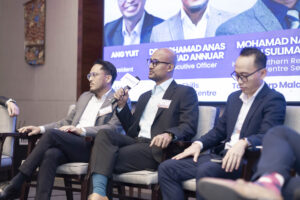
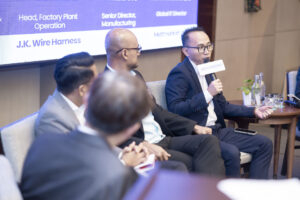
One of the key audience questions focused on an initiative presented by Hafiz, which emphasised empowering operators to conduct their own inspections and become directly accountable for the quality of their work. The approach generated significant interest because it addresses a common challenge faced by many organisations: creating a genuine quality culture rather than relying solely on inspection systems and compliance processes. The audience member noted that encouraging operators to inspect their own work creates greater ownership of outcomes and helps embed accountability into daily operations. This observation sparked broader discussion around how companies can strengthen quality culture throughout the organisation. The concept reflects an important shift in manufacturing philosophy. Rather than treating quality as the sole responsibility of a dedicated quality department, leading organisations increasingly view quality as everyone’s responsibility. When employees understand how their work contributes to product performance, customer satisfaction, and business success, quality becomes embedded into the culture rather than enforced through oversight alone.
The Link Between Quality Culture and Talent Resilience
The discussion highlighted that workforce resilience and quality culture are closely connected. Organisations that successfully build resilient workforces often share several characteristics:
Ownership Mindset
Employees are empowered to take responsibility for outcomes rather than simply completing assigned tasks.
Continuous Learning
Workers are encouraged to develop new skills, adapt to changing technologies, and contribute to process improvements.
Problem-Solving Capability
Teams are trained to identify issues early, investigate root causes, and implement corrective actions.
Accountability Across Functions
Quality and operational excellence are not isolated within specific departments but become shared organisational objectives.
Leadership Commitment
Management actively supports workforce development and demonstrates commitment to continuous improvement.
These principles become increasingly important as companies transition towards Industry 5.0, where human capability and technological advancement must work together.
Why Future-Ready Industries Need Future-Ready Talent
Across manufacturing and industrial sectors, organisations are facing significant workforce challenges. These include:
– Skills shortages
– Aging workforces
– Rapid technology adoption
– Evolving customer expectations
– Increased regulatory requirements
– Global supply chain disruptions
Addressing these challenges requires more than technical training.
The panel emphasised the importance of developing talent that is capable of adapting, learning, and contributing within increasingly dynamic industrial environments. Future-ready talent must combine technical expertise with critical thinking, collaboration, communication, and leadership capabilities. This is particularly important as automation and artificial intelligence continue reshaping the nature of work. While technology can improve efficiency and productivity, human judgement, creativity, accountability, and decision-making remain essential.
The Role of Cross-Border Collaboration in Workforce Development
Another key theme of the discussion was the growing importance of regional collaboration in building talent resilience. As industries become more interconnected, workforce development can no longer be viewed solely through a national lens. Cross-border partnerships between industry, educational institutions, government agencies, and ecosystem stakeholders can help accelerate capability development and strengthen talent pipelines. Such collaborations can support:
– Skills development programmes
– Industry certification initiatives
– Knowledge transfer
– Workforce mobility
– Best-practice sharing
– Leadership development
– Advanced technical training
These efforts help create stronger and more resilient industrial ecosystems capable of supporting future economic growth.
Preparing for an Uncertain Global Environment
The discussion also reflected broader concerns facing manufacturers and industrial organisations worldwide. Recent years have demonstrated how quickly businesses can be affected by global crises, supply chain disruptions, geopolitical shifts, labour shortages, and economic uncertainty. In this environment, organisational resilience becomes a strategic advantage. Companies that invest in workforce development, quality culture, and continuous capability building are often better positioned to navigate disruptions while maintaining operational performance. Resilience is no longer simply about responding to crises. It is about creating organisations that can continuously adapt, evolve, and remain competitive despite changing circumstances.
From Compliance to Culture
One of the strongest messages emerging from the session was that sustainable excellence cannot be achieved through compliance alone. Quality systems, procedures, and standards remain important, but long-term success depends on culture. When accountability, ownership, and continuous improvement become part of everyday behaviour, organisations create stronger foundations for growth. This cultural transformation requires leadership commitment, workforce engagement, and ongoing investment in talent development. Most importantly, it requires recognising that people remain at the centre of industrial transformation.
Building the Workforce of the Future
The panel discussion reinforced a critical insight for manufacturers, employers, policymakers, and industry leaders: The future belongs to organisations that invest not only in technology, but also in people. Building resilient workforces, fostering accountability, strengthening quality culture, and accelerating industry-ready capabilities will be essential for organisations seeking to compete in an increasingly dynamic global economy. As industries move towards more advanced, digital, and interconnected operating environments, workforce resilience will become one of the defining factors separating industry leaders from followers. The future of manufacturing will not be built solely by machines or technology. It will be built by empowered people, supported by strong cultures, equipped with future-ready skills, and united by a shared commitment to quality and continuous improvement.
AIM Asia: Driving Conversations That Shape the Future of Industry
The AIM Asia continues to bring together manufacturers, industry leaders, government agencies, investors, educators, and innovation ecosystem partners to address the most pressing challenges and opportunities facing the future of industry. Through meaningful discussions on workforce development, sustainability, innovation, digital transformation, and industrial competitiveness, AIM Asia remains committed to advancing conversations that create lasting impact across the region.
Connect with AIM Asia
Join us at our upcoming AIM Asia programmes to connect with industry leaders, innovators, governments, investors, and technology providers shaping the future of manufacturing and industrial transformation across ASEAN. Connect with us to gain access to the exclusive AIM Circle platform and stay connected with industry leaders and opportunities across the advanced manufacturing ecosystem.
For AIM Circle access, speaking, sponsorship, exhibition, and partnership opportunities, contact [email protected] or +65 8868 1418 (SG) | +6011 1616 3281 (MY)
#AIMAsia #WorkforceDevelopment #TalentResilience #FutureReadyWorkforce #QualityCulture #OperationalExcellence #ManufacturingLeadership #Industry50 #HumanCapital #SkillsDevelopment #AdvancedManufacturing #IndustrialTransformation #WorkforceTransformation #ContinuousImprovement #FutureOfWork