
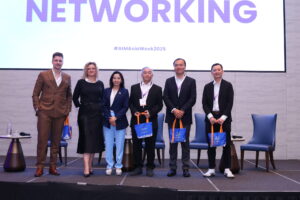
The second panel at the 2nd Annual Advanced Innovation & Manufacturing (AIM) Asia Week 2025, “Uncovering the Future of Artificial Super Intelligence and Automation: From Innovation to Production Towards Industry 5.0”, brought together leaders from across industries to explore how artificial intelligence and automation are transforming operations, design, and innovation in the journey toward Industry 5.0. Moderated by Victor Fasahati, Founder & Managing Partner, Mayflower & Partners, and Board Member, SingCham, the discussion featured panelists:
- Yvonne Keil, Senior Director, GF Operations, GlobalFoundries
- Choong Poh Foong, Senior Manager, Data, Advance Analytics & Insights, HP
- Dr. Yongji Fu, Vice President & Head of R&D, B. Braun Medical Group
- Chee Chun Yee, Director, Product Development, AMD
Key insights from the panel included:
1. Automation Beyond Industry 4.0
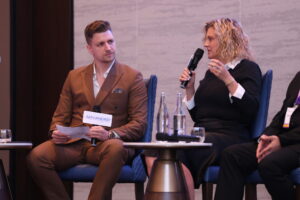
Yvonne Keil shared that semiconductor manufacturing has already achieved nearly 98 percent automation at GlobalFoundries, signaling the maturity of Industry 4.0. The next frontier, she explained, lies in connecting global fabs through a “virtual manufacturing footprint,” where data, resources, and human expertise are integrated seamlessly across geographies. The challenge now is determining which decisions should remain human-driven and which can be fully handled by AI.
2. Data as the Fuel of Intelligence
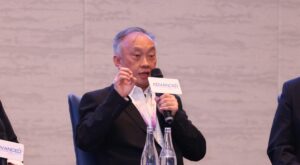
Choong Poh Foong highlighted that AI’s value is inseparable from the quality and organization of data. With data proliferating across every device, he stressed that the real advantage will come from companies that can structure, connect, and convert data into actionable knowledge.
3. AI Accelerating Healthcare Innovation
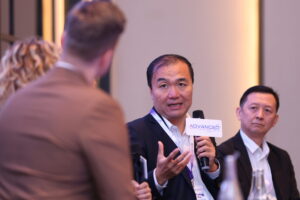
From the medtech perspective, Dr. Yongji Fu emphasized that although healthcare is a highly regulated and cautious adopter, AI is now accelerating product innovation through digital twins, material discovery, and simulation. These tools shorten prototyping cycles and resource use, allowing faster, safer product development, an efficiency underscored during the pandemic.
4. Predictive AI and Design Efficiency
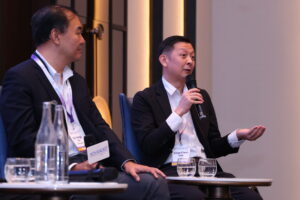
Chee Chun Yee illustrated how AI is being embedded from the earliest stages of chip design, reducing development churn, predicting system failures, and closing the loop between design, validation, and manufacturing. This predictive feedback accelerates time-to-market while maintaining performance and reliability.
5. Balancing ROI and Accessibility
Both Chee Chun Yee and Choong Poh Foong acknowledged that not all companies can afford full-scale digital-twin systems. They advocated for targeted, small-scale AI implementations to demonstrate ROI and gradually build confidence among investors and smaller manufacturers.
6. The Human Role in an Automated Future
Closing the discussion, Yvonne reminded that even in fully automated fabs, human engineers remain indispensable for monitoring, troubleshooting, and strategic oversight. The future of Industry 5.0, she noted, is not about replacing people, but empowering them through intelligence, connectivity, and collaboration.
Where Innovation Meets Intelligence
Industry 5.0 represents the convergence of technology and humanity, where machines amplify human potential and intelligence becomes the catalyst for transformation. It’s a future defined by purposeful innovation, cross-sector collaboration, and sustainable progress, shaping industries that are not only efficient, but empathetic, inclusive, and future-ready.
Take part in advancing the next era of intelligent and sustainable manufacturing.
Join the AIM Asia community for insights and connections.
Save the date: 3rd Annual AIM Asia Week 2026 on 23-24 September 2026. Stay tuned for more details.