
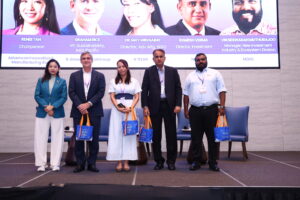
The 2nd day of the 2nd Annual Advanced Innovation & Manufacturing (AIM) Asia Week 2025 opened with a multi stakeholder panel, featuring leaders from industry, research, and government shared how innovation, manufacturing, and investment can align to accelerate sustainable growth across Asia. Moderated by Renee Tan, Chairperson of Advanced Innovation & Manufacturing Asia, the panel featured:
- Graham Rice, VP, Sustainability, Asia Pacific, B. Braun Medical Group
- Dr. May Win Naing, Director, Adv Mfg SERC, A*STAR
- Ramesh Verma, Director, Investment, NCER
- Vikneswaran Muthurajoo, Manager, New Investment Industry & Ecosystem Division, MDEC
1. Innovation and Industry 5.0: Building Long-Term Resilience
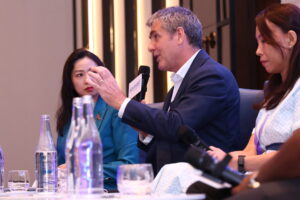
Graham Rice opened by highlighting the intersection between sustainability and innovation under Industry 5.0, noting that technology must evolve within planetary boundaries. For B. Braun, this means advancing decarbonisation, supplier engagement, and circular waste management. He shared that Penang operations have already achieved over 90 % Scope 1 and 2 emissions reduction, with focus now shifting to Scope 3 and supplier sustainability.
Dr. May Win Naing emphasized how innovation directly supports profitability and resilience. Many SMEs still struggle to adopt advanced technologies, yet those that do achieve measurable cost savings and stronger market positions. She cited Rolls-Royce’s automated coating line with local SME KA Industrial and Mencast’s 3D-printed marine propeller that cut material costs by 80 %, proving that digital and process innovation drive both economic and environmental gains.
2. Ecosystem Collaboration: Linking Innovation with Investment
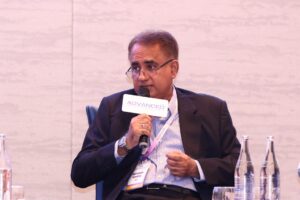
Ramesh Verma underscored the power of cluster-based ecosystems, where industry, academia, and government collaborate to accelerate innovation. NCIA’s initiatives in semiconductors, agritech, and renewables demonstrate how integrated supply chains attract investors and strengthen resilience. He spotlighted the new Advanced Packaging Institute in Penang, projected to contribute RM 8 billion to Malaysia’s semiconductor revenue by 2032.
Building on this, Dr. May explained A*STAR’s approach of giving local companies the innovation mandate, co-developing solutions with MNCs while nurturing R&D and talent within Singapore. This dual strategy enables startups to scale innovation and attracts long-term investment into the nation’s manufacturing ecosystem.
3. Investment and Competitiveness in the Digital Age
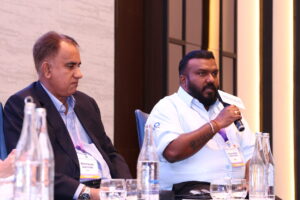
From a national investment perspective, Vikneswaran Muthurajoo shared how MDEC works closely with agencies like MIDA, MITI, and the Ministry of Digital to position Malaysia as a regional hub for high-value digital and semiconductor investments. By offering tailored incentives and ensuring energy and infrastructure readiness, MDEC maintains Malaysia’s competitiveness amid intensifying regional rivalry from Singapore, Vietnam, and Thailand.
4. Challenges and the Path Forward

Panelists agreed that aligning short-term business priorities with long-term sustainability remains a challenge. Graham noted that many firms face timing and infrastructure gaps when trying to achieve carbon-reduction goals, urging a shift toward flexible business models and long-term ROI thinking. Dr. May highlighted funding and manpower barriers for SMEs, explaining that A*STAR bridges these through joint R&D programs and shared AI solutions for manufacturers. Ramesh added that NCIA is moving away from grant dependency toward talent and innovation programs, while Vikneswaran stressed the importance of upskilling Malaysia’s workforce in AI, IC design, and digital technology to ensure global competitiveness.
5. A Unified Vision for Sustainable Growth
Closing the discussion, Graham Rice urged Asia to be bolder in ambition, citing the region’s strong work ethic and adaptability as key advantages. Dr. May called for rethinking engineering processes from the outset to reduce waste and energy use. Ramesh and Vikneswaran echoed the importance of cross-sector collaboration, linking policy, talent, and innovation to transform Industry 5.0 aspirations into reality.
Defining the Next Chapter of Industrial Transformation
The panel reinforced that innovation fuels sustainability, with digitalisation and process improvements boosting both efficiency and profitability. Ecosystem collaboration, bridging government, academia, and industry, remains the foundation for scalable impact. Talent readiness is central to future growth, requiring continuous reskilling and closer academia-industry alignment. Above all, achieving a sustainable economy demands visionary leadership, cross-border cooperation, and courage to balance profit with purpose.
Be part of the AIM Asia ecosystem
Connect with innovators, investors, and industry pioneers transforming ideas into scalable, sustainable solutions for the future of manufacturing.
Join the AIM Asia community for insights and connections.
Save the date: 3rd Annual AIM Asia Week 2026 on 23-24 September 2026 in Penang, Malaysia. Stay tuned for more details.