
At the Advanced Innovation & Manufacturing (AIM) Asia Summit 2026, one of the most thought-provoking discussions explored a topic dominating boardrooms, factories, and innovation ecosystems worldwide: Agentic AI and the future of Human-AI Synergy in Industry 5.0. As manufacturers across ASEAN race to adopt artificial intelligence, automation, and intelligent systems, the session challenged a critical assumption many organisations are currently making that AI should be implemented everywhere. Instead, the discussion highlighted a far more strategic and sustainable approach: AI must serve a clear business purpose, strengthen human capability, and be deployed selectively where it creates measurable value. Moderated by James Ong, the session opened with an energetic and reflective tone, framing the conversation not simply around technology, but around productivity with purpose. He emphasised that the future of manufacturing will not be determined solely by who adopts AI first, but by who understands how to combine human intelligence, creativity, and leadership with machine capability most effectively. James also highlighted the growing urgency surrounding autonomous manufacturing and industrial AI transformation. Referencing global developments such as Jeff Bezos’ reported automation-focused manufacturing ambitions, the discussion underscored that the race towards intelligent manufacturing ecosystems is accelerating rapidly. For manufacturers across Asia, this shift represents both a major opportunity and a significant competitive threat.
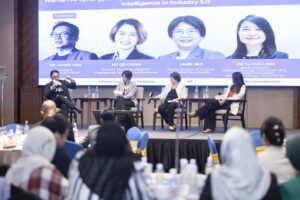
Human-AI Synergy, Not AI Everywhere
A major highlight of the session came from the discussion around Human-AI Synergy, a concept increasingly shaping the future of Industry 5.0. The panel stressed that businesses should not approach AI as a blanket solution for every challenge. Instead, organisations must clearly identify where AI genuinely adds value and where human judgement remains irreplaceable. The discussion explored how AI performs best in areas that are repetitive, data-intensive, operationally complex, or non-core to human creativity and relationship building. Areas such as process automation, troubleshooting support, market intelligence gathering, qualification planning, and data analysis were identified as strong use cases for intelligent AI deployment. However, the panel also emphasised that creativity, strategic thinking, leadership, innovation, and relationship management must remain human-led capabilities. One of the strongest messages throughout the session was clear: AI should act as a partner, not a replacement. Rather than fearing AI, manufacturers should focus on bringing AI alongside human teams to enhance decision-making, improve operational efficiency, and unlock new levels of industrial intelligence.

Why Many Companies Fail in AI Adoption
Another critical insight from the session was the warning against implementing AI without strategic clarity. The panel noted that many organisations rush into AI adoption because of market pressure, hype, or fear of being left behind. However, deploying AI without understanding the actual business problem often leads to failed implementation, wasted investments, and operational confusion. Manufacturers were encouraged to first ask:
– What business challenge are we solving?
– Is this process suitable for AI?
– Does this area require automation, intelligence, or human creativity?
– Will AI improve productivity, insight, or decision quality?
The session reinforced that not every process should be automated. Some areas demand human interpretation, nuanced decision-making, and contextual understanding that AI alone cannot deliver. This balance between machine intelligence and human oversight is what defines true Industry 5.0 transformation.
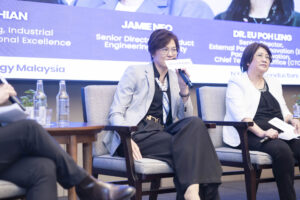
Agentic AI as the Bridge Between Insight and Execution
The panel also explored the growing role of Agentic AI in manufacturing environments. Unlike traditional automation systems that follow fixed rules, Agentic AI introduces more adaptive and intelligent capabilities that can assist with analysis, recommendations, process optimisation, and operational support. The discussion highlighted how Agentic AI can become a powerful bridge between industrial data and actionable execution on the manufacturing floor. Rather than replacing engineers or operators, these systems can help teams:
– Identify process inefficiencies faster
– Improve troubleshooting accuracy
– Support qualification and production planning
– Analyse large volumes of manufacturing data
– Enhance predictive decision-making
– Accelerate learning and operational responsiveness
The panel emphasised that the organisations gaining the most value from AI are those using it to augment human capability rather than eliminate human involvement.
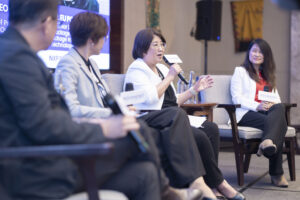
The Industry 5.0 Shift: Humans Remain at the Centre
Throughout the session, a consistent theme emerged: Industry 5.0 is not purely about automation. It is about building intelligent industrial ecosystems where technology and people work together. The discussion reinforced that humans must remain:
– The leaders
– The overseers
– The curators
– The strategic decision-makers
– The creators of ideas and innovation
While AI can process data, automate workflows, and generate insights, human judgement remains essential in determining direction, ethics, creativity, customer engagement, and long-term business strategy. This human-centric approach is becoming increasingly important as manufacturers move beyond Industry 4.0 into a more collaborative, resilient, and intelligence-driven manufacturing era.
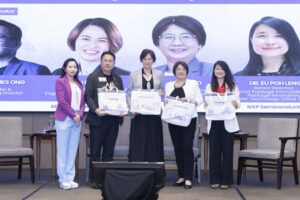
Manufacturing Competitiveness in the AI Era
As global manufacturing competition intensifies, the panel highlighted that companies unable to adapt to intelligent manufacturing transformation risk losing competitiveness over time. The conversation pointed towards a future where:
– Autonomous manufacturing systems become more common
– AI-powered decision intelligence shapes factory operations
– Smart manufacturing ecosystems become the industry norm
– Industrial productivity increasingly depends on data and intelligent systems
However, the panel strongly cautioned against treating AI adoption as merely a technology project. Instead, successful transformation requires:
– Strategic leadership alignment
– Clear operational purpose
– Workforce readiness
– Change management
– Cross-functional collaboration
– Responsible AI implementation
The manufacturers that succeed will be those that understand not only how to deploy AI, but when, where, and why to use it.
Hear from the Panelists:
– Ng Lee Chian, Director, Planning, Industrial Engineering, Operational Excellence, Micron Technology Malaysia
– Jamie Neo, Senior Director, Product Engineering & Quality, HP
– Dr. Eu Poh Leng, Senior Director, External Package Innovation (EPI), Package Innovation, Chief Technology Office (CTO), NXP Semiconductors
Moderator: Dr James Ong, Founder & Managing Director, AI International Institute (AIII)
A Critical Conversation for ASEAN Manufacturing Leaders
As ASEAN continues strengthening its position as a global advanced manufacturing and innovation hub, discussions like these are becoming increasingly important for manufacturers, engineers, policymakers, and business leaders navigating the next phase of industrial transformation. The AIM Asia Summit 2026 once again reinforced its role as a platform bringing together manufacturing leaders, innovators, government agencies, investors, and ecosystem partners to drive conversations around Innovation, Investment, and Impact. This session on Agentic AI and Human-AI Synergy provided practical and strategic insights into how businesses can move beyond AI hype and build purposeful, sustainable, and intelligent manufacturing ecosystems for the future. The future of Industry 5.0 will not belong to companies that simply adopt AI the fastest. It will belong to organisations that know how to combine human capability with machine intelligence most effectively.
Join us at our upcoming AIM Asia series of programs, where we will continue to have important discussions like this.
Contact us at [email protected] or +65 8868 1418 for more information on speaking, sponsorship, exhibition and partnership opportunities.