
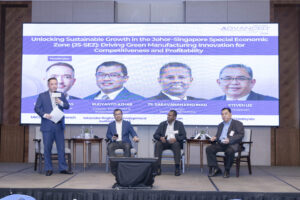
At the Advanced Innovation & Manufacturing (AIM) Asia Summit 2026, one of the key discussions shaping the future of ASEAN’s industrial transformation focused on a critical question facing manufacturers today: How can green manufacturing and cross-border collaboration create real competitive advantage in the Johor-Singapore Special Economic Zone (JS-SEZ)?
As industries across Asia accelerate towards sustainability, digital transformation, and resilient supply chains, the session brought together voices from the private sector, government agencies, and sustainability ecosystems to explore how manufacturers can position themselves for the next era of industrial growth. The discussion highlighted that sustainability is no longer just an environmental initiative or compliance exercise. It is rapidly becoming a core business strategy that directly influences investment attraction, operational resilience, supply chain competitiveness, and long-term economic growth.
The Growing Importance of the JS-SEZ in ASEAN Manufacturing
With the Johor-Singapore Special Economic Zone (JS-SEZ) gaining momentum as one of ASEAN’s most strategic cross-border industrial initiatives, the panel explored how the region can leverage sustainability and green manufacturing to attract higher-value industries and investments. The conversation focused on how the combination of Malaysia’s manufacturing strengths and Singapore’s global connectivity, financial ecosystem, and innovation capabilities can create a highly competitive industrial corridor for advanced manufacturing and technology-driven industries. Rather than competing individually, the panel emphasised that cross-border collaboration allows both ecosystems to complement each other’s strengths while creating a more integrated and resilient regional value chain. As global manufacturers increasingly evaluate supply chain resilience, ESG commitments, carbon reduction strategies, and sustainable operations, regions that can offer integrated green manufacturing ecosystems will have a stronger advantage in attracting multinational investments.

Green Manufacturing as a Strategic Competitive Advantage
A major theme throughout the discussion was that green manufacturing should not be viewed merely as a compliance requirement, but as a long-term competitive differentiator. The panel highlighted how manufacturers that proactively invest in sustainability initiatives are positioning themselves more favourably for:
– Global supply chain integration
– Investor confidence
– Customer trust
– Operational efficiency
– Energy resilience
– Long-term cost optimisation
– ESG-driven partnerships
The discussion reinforced that sustainability is becoming deeply embedded into procurement decisions, investment strategies, and international manufacturing standards. For manufacturers operating within the JS-SEZ ecosystem, green manufacturing can become a major strategic advantage in competing for high-value industries such as:
– Semiconductor manufacturing
– Medical technology
– Electronics and advanced components
– Data centres
– Precision engineering
– Smart manufacturing solutions
– High-tech industrial ecosystems
The panel noted that companies capable of demonstrating strong ESG performance, sustainable manufacturing practices, and energy-efficient operations are increasingly more attractive to multinational corporations and global investors.

Why Cross-Border Collaboration Matters
Another major focus of the session was the role of cross-border collaboration in accelerating sustainable industrial growth. The discussion explored how closer collaboration between Malaysia and Singapore can create:
– Stronger industrial ecosystems
– More resilient regional supply chains
– Faster innovation adoption
– Better talent mobility
– Improved technology transfer
– Integrated sustainability initiatives
– Shared industrial capabilities
The panel emphasised that modern manufacturing competitiveness is no longer determined solely by factory capabilities alone. Instead, success increasingly depends on ecosystem strength, regional integration, and the ability to collaborate across industries, governments, and innovation networks. This is particularly important as ASEAN positions itself as a global manufacturing growth hub amid ongoing geopolitical shifts and supply chain diversification strategies.
Sustainability Is Becoming a Business Imperative
One of the strongest messages from the discussion was clear: sustainability is no longer optional. Across industries, manufacturers are facing growing pressure from:
– ESG regulations
– Investor expectations
– Supply chain requirements
– Carbon reporting obligations
– Energy transition demands
– Customer sustainability expectations
The panel discussed how companies that delay sustainability transformation risk becoming less competitive in the global market over time.
At the same time, organisations that move early and strategically can unlock significant opportunities in:
– Investment attraction
– Market expansion
– Supply chain partnerships
– Talent attraction
– Innovation leadership
– Operational resilience
The session reinforced that green manufacturing is not simply about environmental responsibility. It is increasingly tied directly to profitability, growth, brand positioning, and long-term business sustainability.

The Future of Sustainable Industrial Growth in ASEAN
As ASEAN continues strengthening its role as a global manufacturing and innovation destination, the panel highlighted that the future of industrial competitiveness will depend on how effectively organisations balance:
– Sustainability
– Digital transformation
– Industrial innovation
– Cross-border collaboration
– Talent development
– Energy resilience
– Smart manufacturing adoption
The JS-SEZ was positioned during the discussion as more than just a geographic or economic initiative. It represents a blueprint for how regional collaboration can drive sustainable industrial transformation at scale.
The session also reinforced that achieving this vision requires strong collaboration between:
– Governments
– Manufacturers
– Investors
– Technology providers
– Sustainability leaders
– Industry associations
– Innovation ecosystems
Only through coordinated action can the region accelerate towards a greener, smarter, and more resilient industrial future.

Driving Sustainable Transformation Through AIM Asia
The AIM Asia Summit 2026 continues to serve as a strategic platform connecting manufacturers, innovators, government agencies, investors, and ecosystem leaders to drive meaningful conversations around Innovation, Investment, and Impact across ASEAN. This discussion on green manufacturing, sustainability, and cross-border industrial collaboration reflected the growing urgency for businesses to rethink how they build resilient and future-ready operations in an increasingly complex global environment. As sustainability, AI, advanced manufacturing, and industrial transformation continue reshaping the future of industry, conversations like these are becoming critical for business leaders navigating the next phase of growth. The future of manufacturing will not be driven by technology alone. It will be shaped by how industries collaborate, innovate, and build sustainable ecosystems together.
Stay connected with AIM Asia for more insights on smart manufacturing, sustainability, AI-driven industrial transformation, and cross-border innovation across ASEAN.
Join the exclusive AIM Circle platform to stay connected with industry leaders, insights, and opportunities across the advanced manufacturing ecosystem, https://aim-asias-community.circle.so/aim-asia-circle
For AIM Circle access, speaking, sponsorship, exhibition, and partnership opportunities, contact us at [email protected] or +65 8868 1418.